



Description
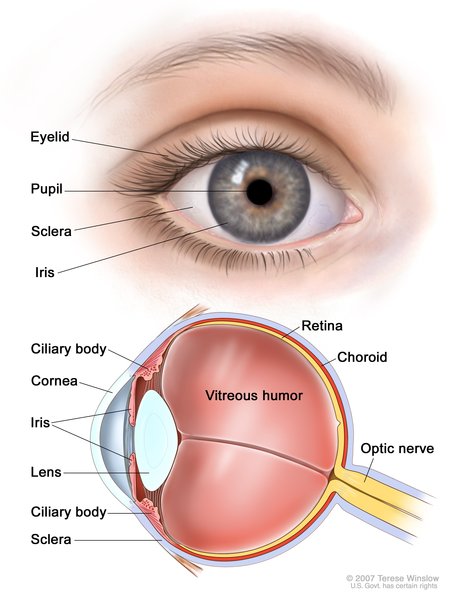
Hermansky-Pudlak syndrome is a disorder characterized by a condition called oculocutaneous albinism, which causes abnormally light coloring (pigmentation) of the skin, hair, and eyes. Affected individuals typically have fair skin and white or light-colored hair. People with this disorder have a higher than average risk of skin damage and skin cancers caused by long-term sun exposure. Oculocutaneous albinism reduces pigmentation of the colored part of the eye (iris) and the light-sensitive tissue at the back of the eye (retina). Reduced vision, rapid and involuntary eye movements (nystagmus), and increased sensitivity to light (photophobia) are also common in oculocutaneous albinism. In Hermansky-Pudlak syndrome, these vision problems usually remain stable after early childhood.

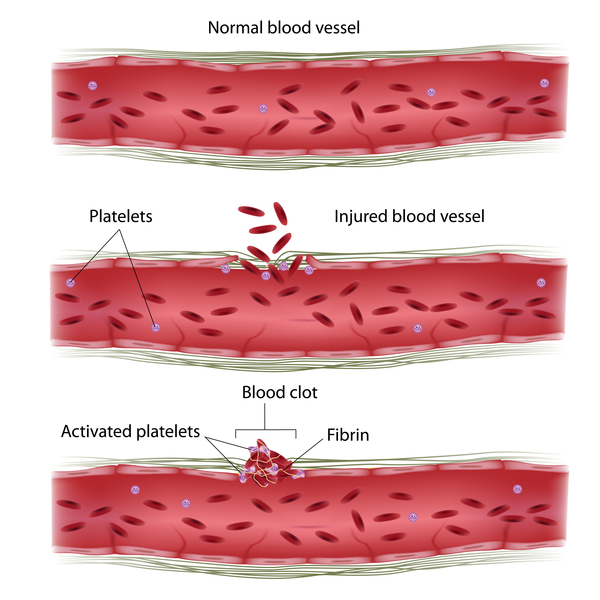
People with Hermansky-Pudlak syndrome also have problems with blood clotting (coagulation) that lead to easy bruising and prolonged bleeding.
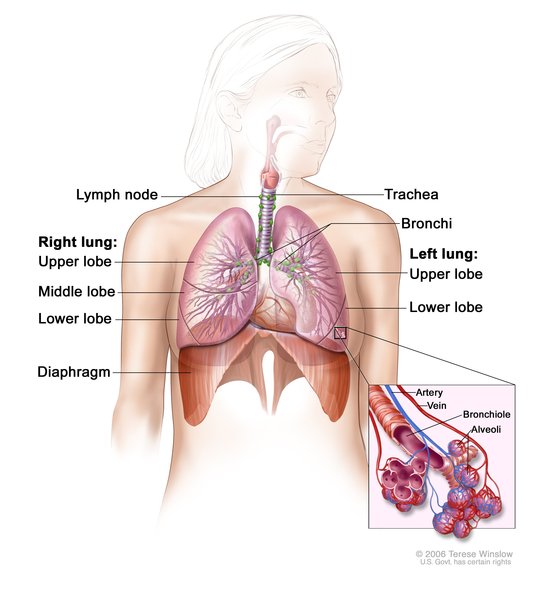
Some individuals with Hermansky-Pudlak syndrome develop breathing problems due to a lung disease called pulmonary fibrosis, which causes scar tissue to form in the lungs. The symptoms of pulmonary fibrosis usually appear during an individual's early thirties and rapidly worsen. Individuals with Hermansky-Pudlak syndrome who develop pulmonary fibrosis often do not live for more than a decade after they begin to experience breathing problems.
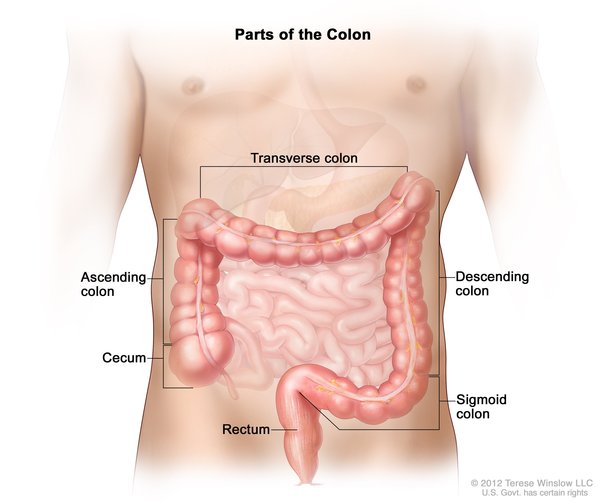
Other, less common features of Hermansky-Pudlak syndrome include inflammation of the large intestine (granulomatous colitis) and kidney failure.
There are nine different types of Hermansky-Pudlak syndrome, which can be distinguished by their signs and symptoms and underlying genetic cause. Types 1 and 4 are the most severe forms of the disorder. Types 1, 2, and 4 are the only types associated with pulmonary fibrosis. Individuals with type 3, 5, or 6 have the mildest symptoms. Little is known about the signs, symptoms, and severity of types 7, 8, and 9.
Frequency
Hermansky-Pudlak syndrome is a rare disorder in most populations and is estimated to affect 1 in 500,000 to 1,000,000 individuals worldwide. Type 1 is more common in Puerto Rico, particularly in the northwestern part of the island where about 1 in 1,800 people are affected. Type 3 is common in people from central Puerto Rico. Groups of affected individuals have been identified in many other regions, including India, Japan, the United Kingdom, and Western Europe.
Causes
At least nine genes are associated with Hermansky-Pudlak syndrome. These genes provide instructions for making proteins that are used to make four distinct protein complexes. These protein complexes play a role in the formation and movement (trafficking) of a group of cell structures called lysosome-related organelles (LROs). LROs are very similar to compartments within the cell called lysosomes, which digest and recycle materials. However, LROs perform specialized functions and are found only in certain cell types. LROs have been identified in pigment-producing cells (melanocytes), blood-clotting cells (platelets), and lung cells.
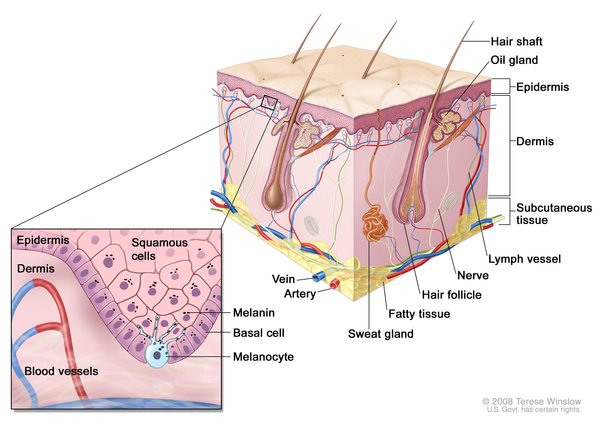
Mutations in the genes associated with Hermansky-Pudlak syndrome prevent the formation of LROs or impair the functioning of these cell structures. In general, mutations in genes that involve the same protein complex cause similar signs and symptoms. People with this syndrome have oculocutaneous albinism because the LROs within melanocytes cannot produce and distribute the substance that gives skin, hair, and eyes their color (melanin). Bleeding problems are caused by the absence of LROs within platelets, which affects the ability of platelets to stick together and form a blood clot. Mutations in some of the genes that cause Hermansky-Pudlak syndrome affect the normal functioning of LROs in lung cells, leading to pulmonary fibrosis.
Mutations in the HPS1 gene cause approximately 75 percent of the Hermansky-Pudlak syndrome cases from Puerto Rico. About 45 percent of affected individuals from other populations have mutations in the HPS1 gene. Mutations in the HPS3 gene are found in about 25 percent of affected people from Puerto Rico and in approximately 20 percent of affected individuals from other areas. The other genes associated with Hermansky-Pudlak syndrome each account for a small percentage of cases of this condition.
In some people with Hermansky-Pudlak syndrome, the genetic cause of the disorder is unknown.
Inheritance
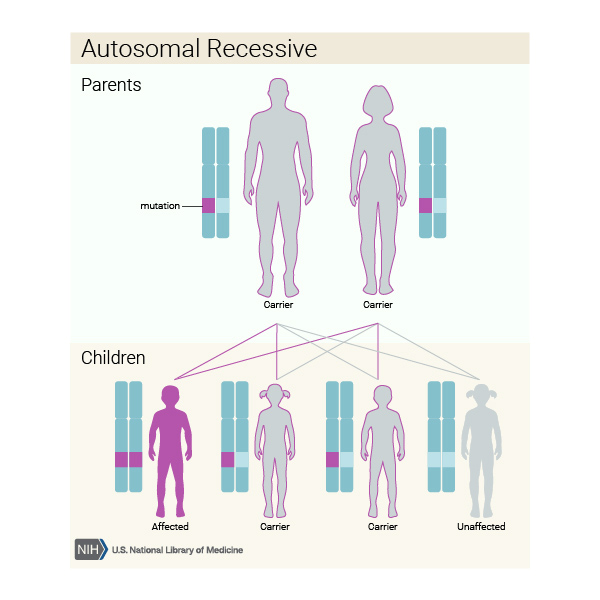
This condition is inherited in an autosomal recessive pattern, which means both copies of the gene in each cell have mutations. The parents of an individual with an autosomal recessive condition each carry one copy of the mutated gene, but they typically do not show signs and symptoms of the condition.
Other Names for This Condition
- HPS
Additional Information & Resources
Genetic Testing Information

Genetic and Rare Diseases Information Center
Patient Support and Advocacy Resources
Clinical Trials
Catalog of Genes and Diseases from OMIM
Scientific Articles on PubMed
References
- Bultema JJ, Ambrosio AL, Burek CL, Di Pietro SM. BLOC-2, AP-3, and AP-1 proteins function in concert with Rab38 and Rab32 proteins to mediate protein trafficking to lysosome-related organelles. J Biol Chem. 2012 Jun 1;287(23):19550-63. doi: 10.1074/jbc.M112.351908. Epub 2012 Apr 16. Citation on PubMed or Free article on PubMed Central
- Bultema JJ, Di Pietro SM. Cell type-specific Rab32 and Rab38 cooperate with the ubiquitous lysosome biogenesis machinery to synthesize specialized lysosome-related organelles. Small GTPases. 2013 Jan-Mar;4(1):16-21. doi: 10.4161/sgtp.22349. Epub 2012 Dec 17. Citation on PubMed or Free article on PubMed Central
- Dessinioti C, Stratigos AJ, Rigopoulos D, Katsambas AD. A review of genetic disorders of hypopigmentation: lessons learned from the biology of melanocytes. Exp Dermatol. 2009 Sep;18(9):741-9. doi: 10.1111/j.1600-0625.2009.00896.x. Epub 2009 Jun 23. Citation on PubMed
- Gahl WA, Brantly M, Kaiser-Kupfer MI, Iwata F, Hazelwood S, Shotelersuk V, Duffy LF, Kuehl EM, Troendle J, Bernardini I. Genetic defects and clinical characteristics of patients with a form of oculocutaneous albinism (Hermansky-Pudlak syndrome). N Engl J Med. 1998 Apr 30;338(18):1258-64. doi: 10.1056/NEJM199804303381803. Citation on PubMed
- Gerondopoulos A, Langemeyer L, Liang JR, Linford A, Barr FA. BLOC-3 mutated in Hermansky-Pudlak syndrome is a Rab32/38 guanine nucleotide exchange factor. Curr Biol. 2012 Nov 20;22(22):2135-9. doi: 10.1016/j.cub.2012.09.020. Epub 2012 Oct 18. Citation on PubMed or Free article on PubMed Central
- Huizing M, Helip-Wooley A, Westbroek W, Gunay-Aygun M, Gahl WA. Disorders of lysosome-related organelle biogenesis: clinical and molecular genetics. Annu Rev Genomics Hum Genet. 2008;9:359-86. doi: 10.1146/annurev.genom.9.081307.164303. Citation on PubMed or Free article on PubMed Central
- Huizing M, Pederson B, Hess RA, Griffin A, Helip-Wooley A, Westbroek W, Dorward H, O'Brien KJ, Golas G, Tsilou E, White JG, Gahl WA. Clinical and cellular characterisation of Hermansky-Pudlak syndrome type 6. J Med Genet. 2009 Dec;46(12):803-10. doi: 10.1136/jmg.2008.065961. Epub 2009 Oct 20. Citation on PubMed or Free article on PubMed Central
- Hurford MT, Sebastiano C. Hermansky-pudlak syndrome: report of a case and review of the literature. Int J Clin Exp Pathol. 2008 Jan 1;1(6):550-4. Citation on PubMed or Free article on PubMed Central
- Introne WJ, Huizing M, Malicdan MCV, O'Brien KJ, Gahl WA. Hermansky-Pudlak Syndrome. 2000 Jul 24 [updated 2023 May 25]. In: Adam MP, Feldman J, Mirzaa GM, Pagon RA, Wallace SE, Bean LJH, Gripp KW, Amemiya A, editors. GeneReviews(R) [Internet]. Seattle (WA): University of Washington, Seattle; 1993-2024. Available from http://www.ncbi.nlm.nih.gov/books/NBK1287/ Citation on PubMed
- Ito S, Suzuki T, Inagaki K, Suzuki N, Takamori K, Yamada T, Nakazawa M, Hatano M, Takiwaki H, Kakuta Y, Spritz RA, Tomita Y. High frequency of Hermansky-Pudlak syndrome type 1 (HPS1) among Japanese albinism patients and functional analysis of HPS1 mutant protein. J Invest Dermatol. 2005 Oct;125(4):715-20. doi: 10.1111/j.0022-202X.2005.23884.x. Citation on PubMed
- Li W, Feng Y, Hao C, Guo X, Cui Y, He M, He X. The BLOC interactomes form a network in endosomal transport. J Genet Genomics. 2007 Aug;34(8):669-82. doi: 10.1016/S1673-8527(07)60076-9. Citation on PubMed
- Santiago Borrero PJ, Rodriguez-Perez Y, Renta JY, Izquierdo NJ, Del Fierro L, Munoz D, Molina NL, Ramirez S, Pagan-Mercado G, Ortiz I, Rivera-Caragol E, Spritz RA, Cadilla CL. Genetic testing for oculocutaneous albinism type 1 and 2 and Hermansky-Pudlak syndrome type 1 and 3 mutations in Puerto Rico. J Invest Dermatol. 2006 Jan;126(1):85-90. doi: 10.1038/sj.jid.5700034. Citation on PubMed or Free article on PubMed Central
- Wei AH, He X, Li W. Hypopigmentation in Hermansky-Pudlak syndrome. J Dermatol. 2013 May;40(5):325-9. doi: 10.1111/1346-8138.12025. Citation on PubMed
- Wei AH, Li W. Hermansky-Pudlak syndrome: pigmentary and non-pigmentary defects and their pathogenesis. Pigment Cell Melanoma Res. 2013 Mar;26(2):176-92. doi: 10.1111/pcmr.12051. Epub 2012 Dec 31. Citation on PubMed
- Young LR, Gulleman PM, Bridges JP, Weaver TE, Deutsch GH, Blackwell TS, McCormack FX. The alveolar epithelium determines susceptibility to lung fibrosis in Hermansky-Pudlak syndrome. Am J Respir Crit Care Med. 2012 Nov 15;186(10):1014-24. doi: 10.1164/rccm.201207-1206OC. Epub 2012 Oct 4. Citation on PubMed or Free article on PubMed Central
The information on this site should not be used as a substitute for professional medical care or advice. Contact a health care provider if you have questions about your health.